Sunday, June 13, 2010

Mystical, mesmerising Mezquita de Cordoba


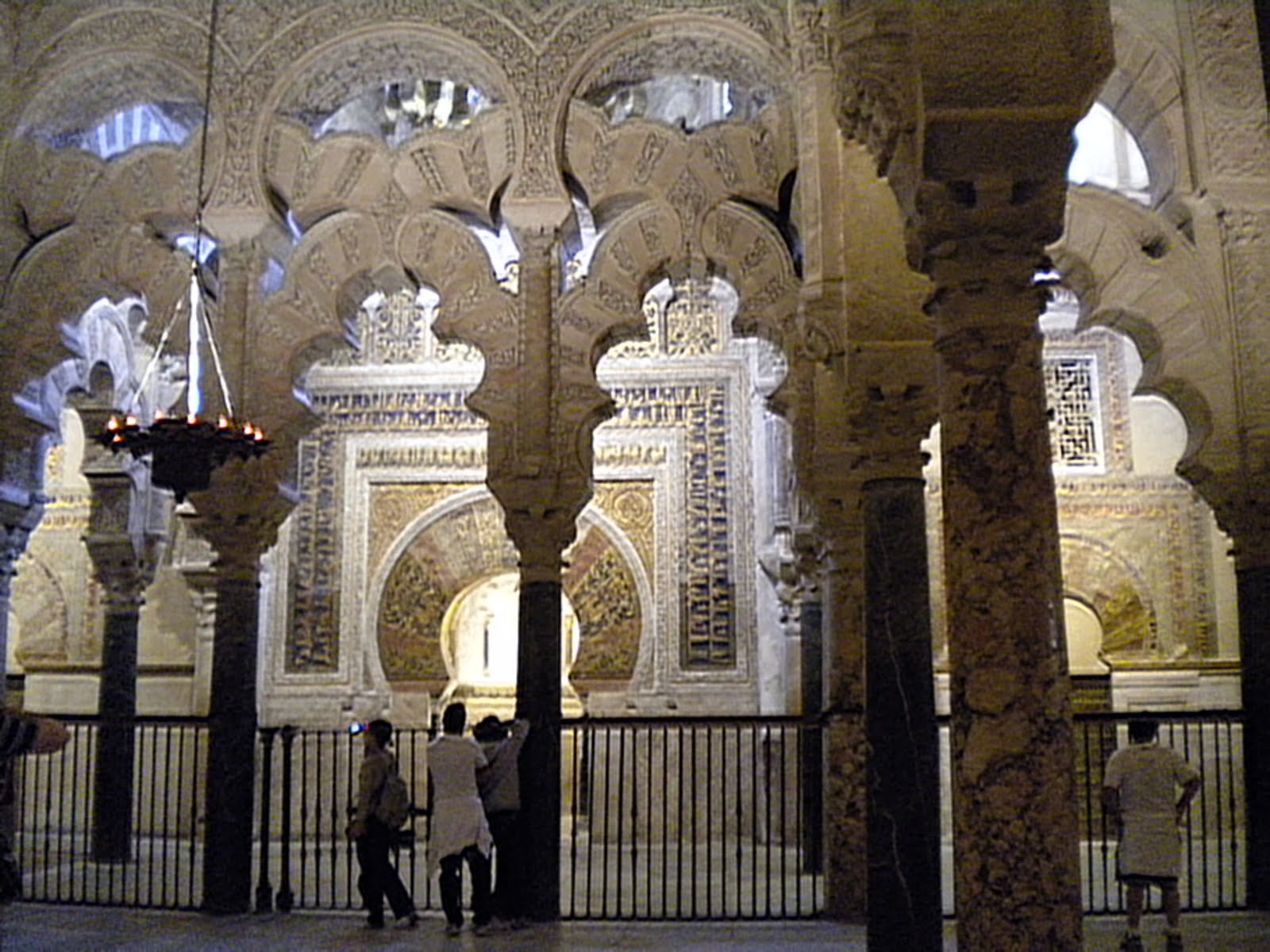
The Mezquita, or mosque, is the highlight of our trip for John, the one thing he most looked forward to seeing and experiencing. Construction commenced on the Mezquita in 784CE under Emir Abd-ar-Rahman, on the site of a Roman temple and it took over two centuries to be completed. It once held an original edition of the Qu'ran and an arm bone of the prophet Mohammed. The Mezquita served the Cordoba Moorish community for several centuries, then in 1236 Cordoba was taken from the Moors by King Ferdinand III and once again became a Christian city. Fortunately Ferdinand admired and respected the Mezquita and instead of razing it he consecrated it as a Catholic church and over the ensuing years it was remodelled to include a Catholic cathedral in the centre of the original structure, with naves, a 'choir', and the usual assortment of Catholic statuary, paintings and frescoes, some created over the top of the existing columns and arches. It is a unique and intriguing architectural oddity, with its own unique atmosphere, that simply cannot be described in words. The Mezquita occupies 24,000 square metres (2.4 hectare,; 6 acres; more than twice the size of our property). 856 of the original 1,293 onyx, marble and granite columns still stand. The repetition of striped arches, comprising red brick and grey/white stone, between the columns, extending as far as the eye can see lends an air of serenity and holiness. This contrasts markedly with the Catholic cathedral in the centre of the mosque, so highly decorated in gold and silver with statues of many sizes and colours, as well as paintings and other Catholic icons. It is almost too much for the eye to take in and the brain to comprehend. So here we were - standing in an intact architectural and spiritual masterpiece that is almost 1,300 years old. Quite an experience.

Thursday, June 10, 2010

Granada - grey skies, but great city


A change in the weather has been a welcome relief with temperatures of 20 to 26 degrees, grey skies and rain overnight - but not today. Granada is situated in the region of Andalusia at the foot of the snow-capped Sierra Nevada mountains. It was the last Moorish capital on the Iberian peninsula and is full of Moorish palaces and Christian Renaissance treasures. Granada is a blend of the old and the "new". The Hop-on-hop-off bus transported us around this interesting city, full of contrasts. Apart from The Alhambra, the cathedral was a stand-out. Dating from the early 16th century (shortly after the Catholic rulers Isabella and Ferdinand wrested control of Granada from the Moors), it is enormous inside - as we have come to expect - with two huge organs and their massive pipes suspended high above our heads, and you can only imagine the sound that would issue forth from them(see photo). We also visited the Capilla Real and its crypt, containing the bodies of Isabella and Ferdinand. The Sacristy contains their crowns, sceptre and sword as well as a Boticelli painting. We visited two more churches - Santa Ana 1537 (Moorish/Christian in style) and San Gregorio, built on a Christian burial site during the times of the Nasrid King. Before lunch we walked through the Garcia Lorco park which also contains Lorco's former summer house. Lorco was a famous Granadan author and playwright who was unfortunately shot dead by a firing squad during the Spanish Civil War (1936-1939) for saying the wrong thing. We stopped for tapas in the area near the university and learned that in Granada tapas plates are complimentary with every drink purchased. They are generous servings with ingredients such as deep fried king prawns or calamari, with salad and chips. We explored the old Moorish region and the labyrinth of narrow streets in the Arabic region, stopping at a teteria (tea-room) for Tunisian tea (green tea with mint and pine nuts)and a milkshake which included rose petals and crushed almonds, accompanied by delicious crepes with strawberries and chocolate. Tomorrow - Cordoba.

The Alluring Alhambra


The Alhambra Palaces, fortress and the adjacent Generalife Gardens are so breathtaking that they deserve their own blog. The Moors crossed the strait of Gibralter in 711 and settled in what was then a small Visigoth town perched on top of The Alhambra hill. This was the foundation of the prosperous and influential civilation that was to hold sway on the Iberian peninsula and through other parts of Europe for almost seven centuries. The fortress, palaces and surrounding buildings were constructed between the 11th and 15th centuries and housed the Sultans and their families, as well as several thousand public servants and other servants. Gardens were established to grow produce for all these people and aqueducts carried water from the Sierra Nevada mountains (which still have snow on their peaks today). The beauty of the buildings and the intricacy of the stuccos and mosaics is stunning. The palace garden has, since the early 20th century, been remodelled to reflect an English country garden style - beautiful and relaxing to meander through. Because the Alhambra is so high it commands wonderful views of the city and the mountain ranges. The Moors eventually ceded occupation of the Alhambra to Emperor Ferdinand and Queen Isabella of Spain in 1492, and it said that as the last Sultan, Boabdil, walked down the wide boulevarde away from The Alhambra for the last time, he looked back and wept (prompting a rebuke from his mother, who accused him of being too weak to successfully defend the town). After the Christain re-occupation of Granada and The Alhambra, Emperor Carlos built another palace within the complex but this does not compare to the original Moorish palaces. Many of the buildings were destroyed or damaged by Napoleon's troops as they retreated from Lord Wellington in the early 19th century and unfortunately only three of the original six palaces remain intact. Today - more of Granada.

Tuesday, June 8, 2010

Holy Toledo..... (Batman)


This certainly is a holy town and is also World Heritage-listed. Toledo sits 530 metres above sea level on a steep rocky outcrop, and for a long time Jews, Muslims and Christians lived in harmony here. Over the centuries Toledo has been a Celti-Iberian city, a Roman outpost, a Moorish-Muslim city, the capital of unified Spain and a recognised cultural and intellectual centre within Europe. Toledo is the town that inspired the famous artist El Grco and is the point of departure for the adventures of Cervantes' Don Quixote. Our two days have been filled to overflowing with historical and cultural sites. The highlight was the magnificent Cathedral, which words can hardly describe. Construction started in 1226 and was not completed until 1493. It is one of the most outstanding examples of Gothic architecture in Spain, indeed in all of Europe. It measures 120 metres by 60 metres and contains five naves supported by 88 pillars, each with a circumference of about 14 metres, and 72 vaults, as well as more than a dozen family chapels. The sacristy houses paintings by El Greco, Goya and Carravegio (to name just three of the noted artists on display) as well as the original robes of bishops and archbishops dating back to the 15th century. The Custodia de Arfe, a magnificient gold and silver monument about three metres tall and housed in the Treasure Room, is made up of 18kg of pure gold and 183kg of silver, and contains 260 small, detailed statuettes of gold and silver. The Treasure Room also houses a 1258 bible with gold-leafed artwork. The 'Choir' section of the Cathedral is hailed as the most beautiful of all the European cathedrals (see photo). Unbelievable artwork and monuments throughout and the whole scale of the building is awe-inspiring. We also visited the Iglesie de Santo Tome, a modest church in comparison but containing El Greco's masterpiece 'The Burial of the Count of Orgaz'. Next was San Juan de los Reyes, a Franciscan monastery where the chains of Christian prisoners who were liberated in Granada in 1492 can be seen dangling from the walls. We also visited a beautiful Jesuit church and climbed up into the towers for impressive views over Toledo and the surrounding countryside. Then off to the Mezquite del Christo de la Luz - the 1,000-year-old mosque - and the Sinagoga Santa Maria la Blanca - the Jewish synagogue - to experience the contrast in expressions of faith; not a statue or painting in sight. Toledo is also famous for its steel and examples of its products, particularly swords, knives and armour, can be seen everywhere. It is also famous for marzipan - quite a contrast. This week Toledo has celebrated the Festival of Corpus Christi, as it has done since the 13th century, and the streets are adorned with flowers and tapestries that made this fascinating town all the more beautiful. It has been a wonderful place to visit but we are completely wrecked from walking the steep, cobbled streets in 38 degree heat. Right now we'd welcome a plain in Spain, or even some rain in Spain. Today - we leave Toledo to catch the train in Spain, back to Madrid then on to Granada.

Saturday, June 5, 2010

Castila Y Leon - "The true heart of spain"


Yesterday we went on a bus tour out of Madrid to the old towns of Avila and Segovia. Avila is surrounded by an impressive intact medieval wall and is the perfect place to stroll narrow laneways and soak up the history. We visited the convent of Saint Teresa who was the reformer of the Carmelite nun order.It was built in 1636 and her original bedroom as a child was turned into a very ornate chapel. Her ring finger (complete with ring) was removed after death and is now on display in a beautiful glass container (yuck). We also visited the lovely 12th century cathedral, the first gothic style church built in Spain. The market square was packed with locals buying their fresh produce as they have done every Friday for the past 8oo years. We then took a 60 minute drive to Sergovia and were greeted by the enormous remains of the Roman aquaduct (over 2000 years old) which was used to transport water 16 kms down the mountain to the city. Our next stop was the very impressive cathedral that contained many individual chapels, originally bought by the rich families of the day. These were highly decorated in gold and enclosed within ornate timber and metal gates. Next was a visit to the Alcazar (palace, or castle) that was built in the late 15th century by Emporer Ferdinand and Queen Isabella (who, incidentally, financed Columbus' voyage that led to the discovery of the Americas). Unfortunately Ferdinand wasn't all that impressed with the finished product and he had another palace built in the mountains. Nonetheless it is an imposing building which is said to have inspired Walt Disney (as you will see from the photo). Today is Elizabeth's birthday, so hopefully we will have a reasonably easy day, visiting the Centro de Arte Reina Sofia (containing the best of Madrid's modern art, including works by Picasso and Salvador Dali) and the Thyssen Museum and having a nice dinner tonight. Tomorrow - Toledo.

Thursday, June 3, 2010

Magical Madrid


Madrid, modern Spain's capital, is and exciting and vibrant city. We explored most of it via the Hop-on-hop-off bus system. Within walking distance of our hotel is the Parque de Buen Retiro, a massive and beautiful park containing, among other things, the Palacio de Cristal, a huge and beautiful glass house (growing pumpkins half a metre in diameter) and an artificial lake big enough to accommodate dozens of rented row boats. We spent several hours at the Museo del Prado, one of the best and most important galleries/museums in the world. It is filled with works by Goya, El Greco, Rubens, Rembrandt as well as other famous European artists. The building was used as cavalry barracks for Napoleon's troops during their occupation of Madrid (1808-1813). Next stop was the Palacio Real, the former royal palace built by King Juan Carlos I. It contains 2,800 rooms of which 50 are on show for the public. These are highly ornate and beautifully furnished with original furnishings. As well as the residence, we saw the palace's original pharmacy with fascinating displays of medicine jars, scales and cooking apparatus. There was also a comprehensive display of armoury from the 16th and 17th centuries. The highlight of the palace for John was the display of 2 violins, 1 viola and 2 cellos made by Stradivari between 1696 and 1705. We lunched at Plaza Mayor - a massive town square whose walls are frescoed and where heretics were burned at the stake during the Spanish Inquisition just a few centuries. John managed to make friends with one of the street mimes - Neptune - and we have now made it back to our hotel in the 35 degree heat to shower and prepare for another delicious dinner. Tomorrow - Avila and Segovia.

Wednesday, June 2, 2010

Milan and Barcelona


It was sad to leave Volterra, but after returning our car to Florence we hopped on the train to Milan for a quick overnight stay. We had time to take in the magnificent Duomo and the adjacent gallery of exclusive shops, La Scala opera theatre, Saint Babila church and a beautiful local park. We flew to Barcelona early afternoon on Sunday and over two days trekked, jumped on and off buses and saw most of the sights. Barcelona seems obsessed with the architect Antonio Gaudi (1852 - 1926) who designed such diverse features as statues, houses, a fantasy park and the still-unfinished cathedral, La Sagrada Familia - a bizarre sight that reflects Gaudi's fascination with nature. The natural design of a cactus flower we saw in a hilltop park (reached by cable-car) can be seen reproduced in part of the cathedral design. We are now in Madrid for four nights and will be hopping on and off buses again tomorrow as we explore this great city.